Disparate Spirits:
Wood Sculpture and Installation
Exhibition Essay
The fact that hundreds and thousands of artists living and working within the same generational time frame produce drastically different work never fails to amaze me, especially when I reflect on the many who have chosen to use the same material.
Obviously, most differences originate from greatly divergent sensibilities, ideas, cultural conditioning, geographic factors, personal histories and last, but not least, limitations inherent in that material.
Nothing however, compares with or supersedes those individual characteristics in mental and emotional make-up which will inevitably saturate the content of the work. Such energies as emanate from the three individual artists in this exhibition inform their work which in each case, while it demonstrates both maturity and a remarkable level of achievement, is as distinctly different from one another as can be.
Alison Saar
Alison Saar’s sculptures manifest as life-sized figures bearing visual clues. This allows them to function as both representations and symbols. Highly accessible and based on the human physiognomy they appear as roughly hewn human figures, whose forms stand on their own, even when they take on the role of historic personages.
Aesthetically related to tribal art they bear a visual kinship to archaic Greek deities, ancient grave guardians, and folk art of various ethnic origins. They can be seen as objects of veneration or simply embody characters inspired by humans engaged in daily tasks. Some may have just finished performing a holy ritual, while others are depicted simply as they are – going about their business. Whatever the nature of their role they usually appear in a frontal position confronting the viewer face to face.
The artist does not intend them to be the likeness of anyone in particular –these are not portraits, nor are they total fiction. She describes them as follows: “…some of them are historical –some of them are personal, people I meet …sometimes its people I see from the windows and just make up stories about. And some are combinations.”
Upon closer observation as one moves beyond the obvious outward clues, they hide little details like secrets one must discover rather than wait to have them revealed. Loaded with all kinds of ideas they carry complex meanings often indicative of cultural markers.
One can hardly escape feelings of curiosity and a strong desire for further exploration as each step builds on the previous one, continuously enriching the experience. A gesture can take you to a new line of investigation, while objects added to the sculpture can either augment the mystery or illuminate the story, hinting at a more elaborate scenario. Alison Saar’s art exists as all good art does – on many levels – as an aesthetic statement; messenger for multiple meanings and/or commentaries about social conventions; the many faces of injustice; the empowerment of freedom; or the tragedy inherent in human history. It speaks to us about us. It speaks of courage and cowardice, of prejudice and righteousness, of pain and joy, and deliverance.
Mike Rathbun
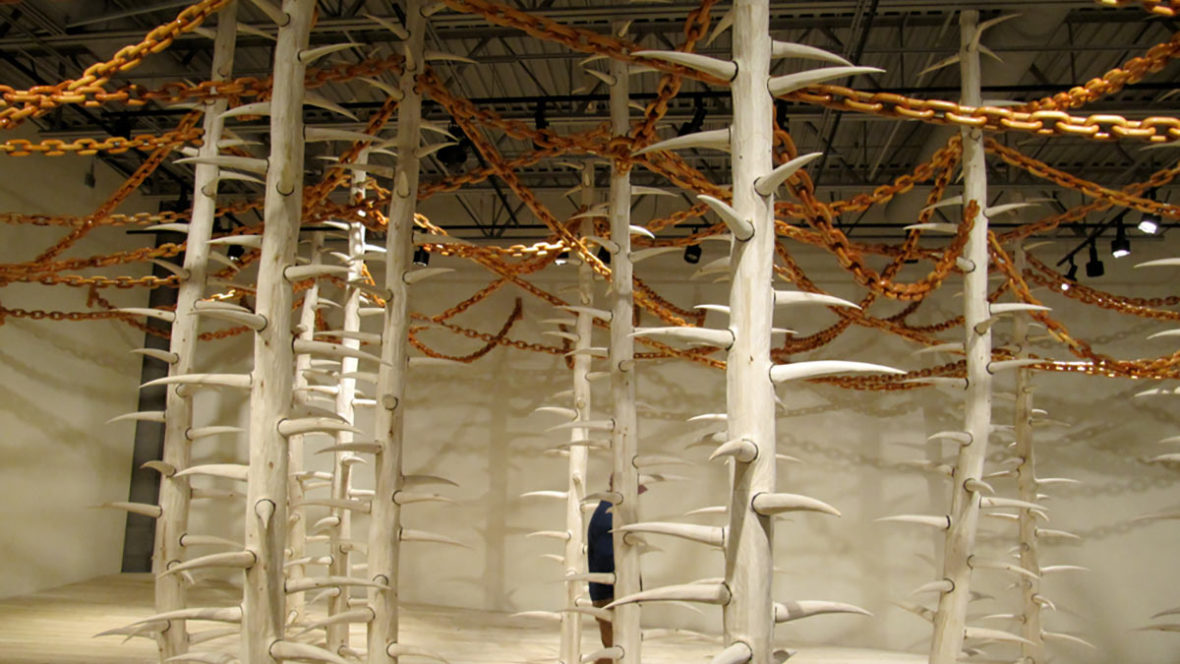
Mike Rathbun’s muscular installations attest to his great stamina, his boundless energy, and the breadth of his ideas. When I first encountered his work, my imagination led me almost automatically to visions I did not fully understand. I felt as if I was in the midst of a primeval landscape where giant trees were growing in such close proximity that the forest floor was covered in dense shade emanating muffled silences and invisible threats.
Among other sensory feelings the artist evokes and explores are the taste of fear; the dangers rising from the unseen and always present powers of nature. In his work there is an unstated struggle of heroic proportions as he confronts his own imagination with untold bravery. Since that imagination is untamed and larger than life, his struggle is one for heroes.
In various mythologies, heroes are often demi-Gods. In spite of that, they have to defeat their own fears as a prerequisite to every battle they are forced to engage in. Conditioned as we are to be prudent we often stumble between what we wish to be and what we really are. Restraint is the enemy of heroism.
Then I ask myself what does heroism mean to me? Through the fog of time I remember the equestrian statues I saw in the town I grew up in—the riders were always heroes—sitting high in the saddle pulling the reins of the rearing bronze stallions whose explosive power had to be held in check lest they would fall off their pedestals. With the eyes of the child that I was then, I understood that the raw energy of the horse if unchecked would court disaster and therefore, the hero had to restrain the stallion to save them both. In bronze, restraints work well. Romantic heroes, however hate restraints. Rathbun’s ideas turn into forms that have to conform to his vision. The scope of his vision and its realization are determined by willpower.
His installations are physical expressions of his state of mind, emotions, thoughts, dreams and insights. He needs that willpower to persist in his labors, to vanquish all physical obstacles, in order to summon all of his powers to attain his goals. Each installation is different, yet they all are born of his robust undaunted spirit—his indomitable will, his hand-carving power, his unbridled ambition, and his worship of the heroic.
Scott Trimble
I walked into the gallery to see Scott Trimble’s installation without knowing what to expect—my eyes soon focused on a maze of meandering wooden ribbon-like forms unraveling as they hugged the contours of the walls. I followed their linear paths the way one follows a map when one embarks on a journey (whether real or symbolic). Only to find oneself at the center of the sculpture expanding in many directions punctuated by small platform-like resting places which interrupt the journey and with each platform supporting a different miniaturized architectural structure.
These made you purposely stop in your tracks to be able to reflect, to see and to study the tiny structures. One, an exquisitely airy spiral staircase, the next an intricately detailed bridge or a flight of steps leading to another flight of steps which ends at a door that is never meant to open.
All these small architectural marvels were individually and precisely constructed to function as systematic building blocks to be assembled later into an overall sculpture. Custom–milled by the artist out of regionally grown cedar these elements were transformed by him into intricate fragile components of a versatile multi-purpose sculpture. These were meant to function as interchangeable blocks that adapt to fit various wall configurations, thus enabling the artist to sustain interest and maintain the surprise every time the work is resurrected to appear in a new incarnation.
Resuming our journey, we rejoin the sculpture’s meandering paths from one platform to another; sometimes moving straight ahead, only to digress, change course, and follow one or another of the crisscrossing paths to meet again at some other of the many forks in the road.
By sending us on this adventure strewn with delightful diversions, the artist has constructed a tactile visual message endowed by the poet in him with symbolic properties…the journey we have undertaken when we first started looking…and slowly have come to understand. No matter what turn one takes new dilemmas will await around each and every corner—new decisions will have to be made—for as long as the journey lasts.
The artist comments: “Some of us choose out of bliss, love, tradition, caste, religion, indecision and some even rely on fate…these paths and divergences are a metaphor for the many directions and choices we will encounter.”
-Josine Ianco Starrels – Curator
Curator
Josine Ianco Starrels
Artists
Alison Saar
Mike Rathbun
Scott Trimble