Will Martin:
Seed Systems
Artist Bio
Willard K. Martin was born April 6, 1930 in Sullivan, Missouri. He was raised on a 200 acre farm in the Ozarks, part of the original farm homesteaded by his grandfather, a circuit-riding judge. His family moved to Oregon when he was a teenager and he attended high school in Albany, Oregon. During the Korean War, Martin was in the U.S. Air Force for three years, after which he went to Paris to study at the Ecoles D’Art Americaines. In 1957 he completed his architectural degree at the University of Oregon where he had studied painting as well as architecture. He had considered a career in the fine arts before he chose architecture as his life’s work. He died in September 1985 in a plane crash.
Exhibition Statement
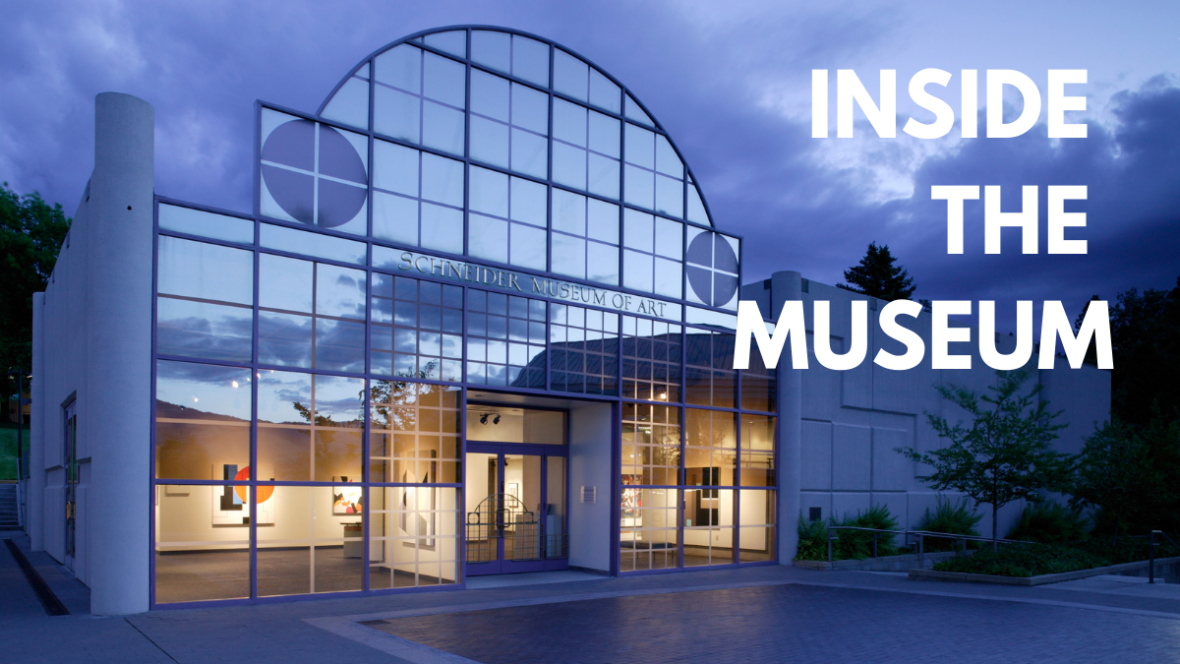
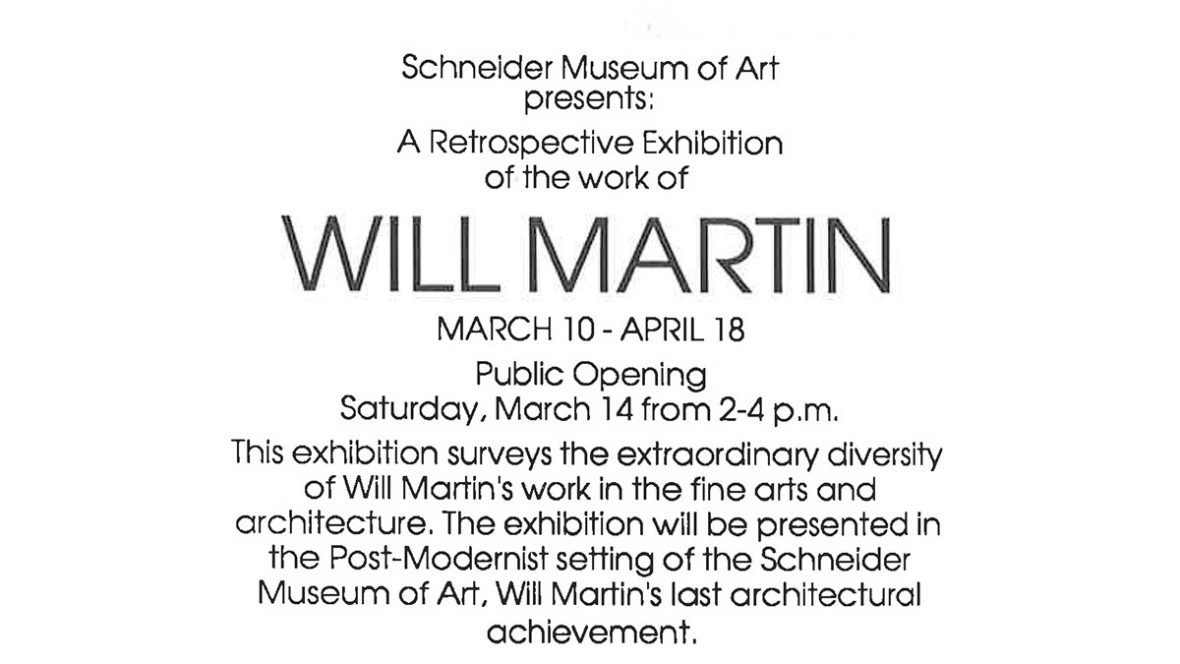
This exhibition surveyed the extraordinary diversity of Will Martin’s work in the fine arts and architecture. The exhibition was presented in the post-modernist setting of the Schneider Museum of Art, Will Martin’s last architectural achievement.
Included in the exhibition were Martin’s architectural renderings and scale models of some of his designs, also watercolor studies and pen & ink drawings of seed pods, and paintings and drawings of landscapes.
Architecturally, Will Martin’s style was a “creative style rooted on nature and dedicated to the idea that man-made things should complement nature — even emulate it — but never compete with it for attention” (Hayakawa, 1984). Martin was the head of the architectural firm of Martin, Soderstrom, Matteson Architects Portland, Oregon. He was the architect for Pioneer Courthouse Square in Portland, the College of Education on the University of Oregon campus, as well as the Schneider Museum of Art. His emphasis was on the appropriateness of a design which influenced the type and style of his buildings throughout the Pacific Northwest. Most of his buildings “display a careful, deliberate ordering of space around a rectilinear axes”. Aesthetically, his architectural works range from “spare and elegant” to “whimsical”. The private residences that he designed were “delicately modernist” and often on spectacular building sites.
Will Martin’s last architectural achievement fulfilled what he said was “every architect’s dream” – that of building a museum. He wanted to create a museum “which would be a ‘rare, small jewel’ that will enrich the community and provide educational and artistic experience for people of all ages”.
Architect/Artist
Will Martin